
Dear Friend,
I hope this message finds you well and easing into a bit of summer joy.
What fruits are growing in your backyard or neighborhood? Here in Bir, we have another seedling being planted — below you’ll find a sweet and meaningful story about Jaime, one of SINI’s English teachers, who is currently teaching Greek to our monastics in Bir, Himachal Pradesh. Please feel free to reach out to me directly, if you have an idea about how best to support our monastics. Thank you for your continued interest.
With appreciation, Tsering Gellek
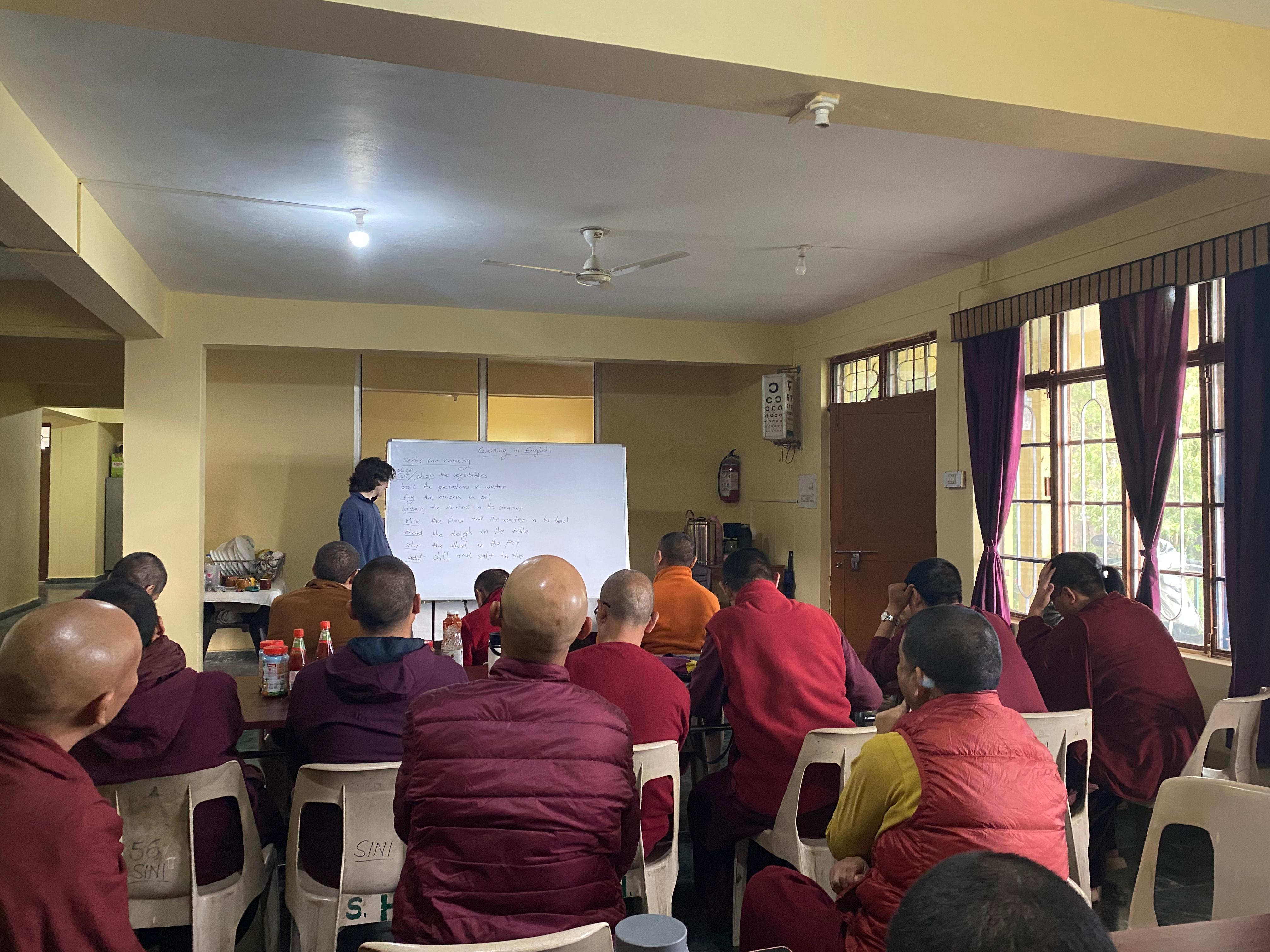
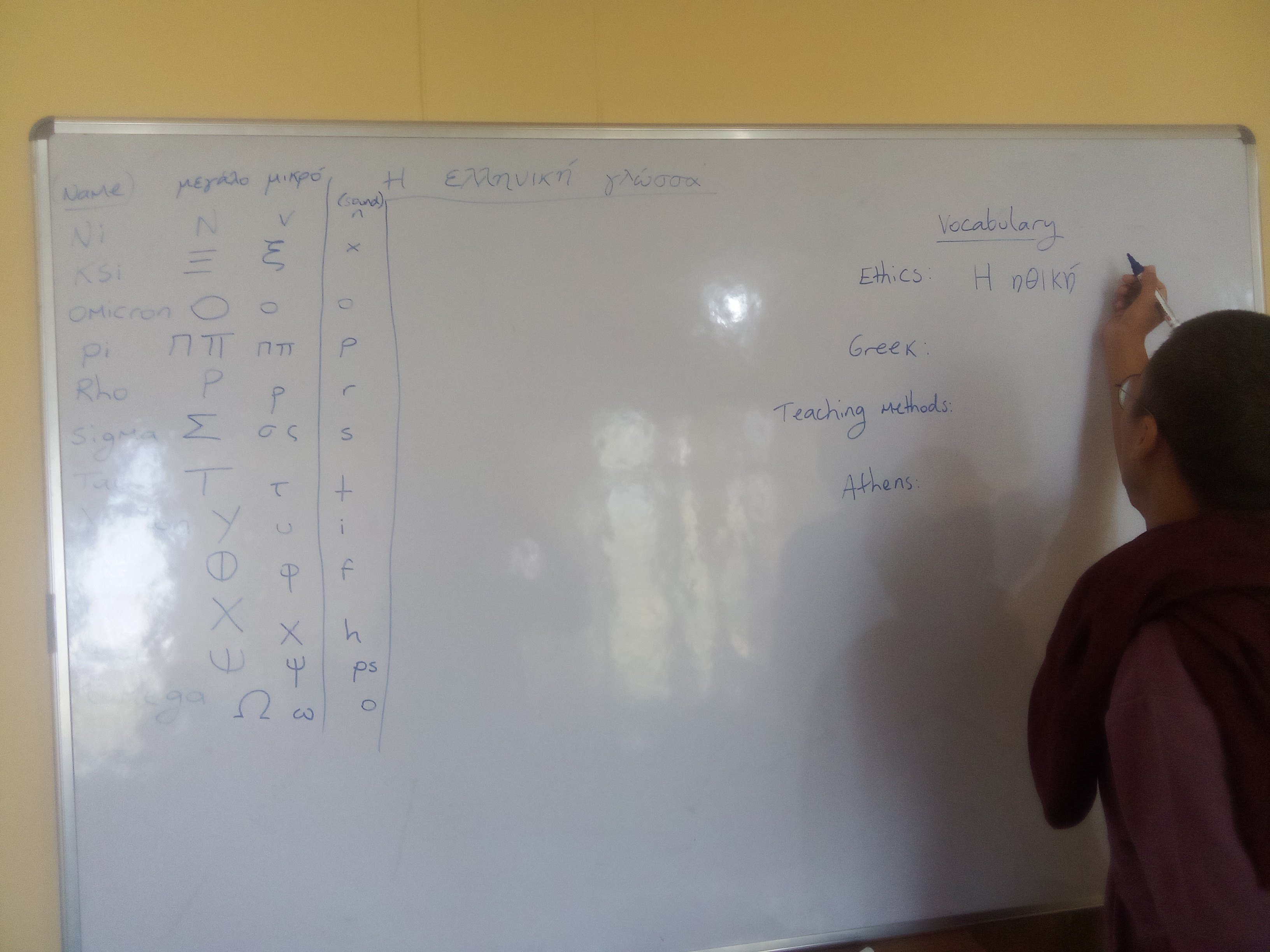
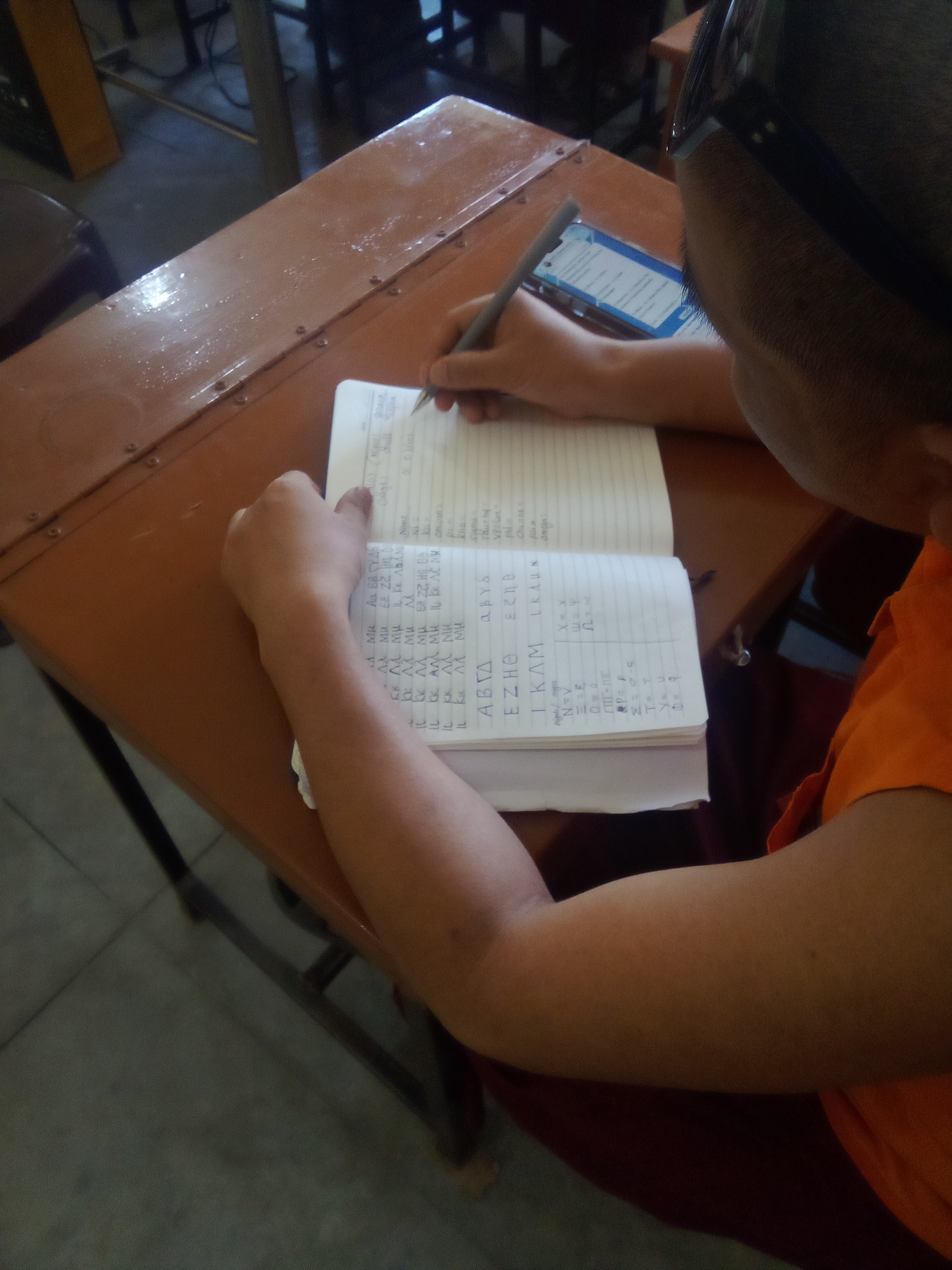
Eleven EDP students are learning the Greek alphabet this summer in Bir, India.
It started with one student, who had become interested in English etymology. One evening, he asked his teacher, Jaime: “Can you help me to learn Greek?”
Jaime Luria Pinto had studied some Greek at university, so he offered to teach the basics of the language to the student and to anyone else interested. Eleven monks signed up. Why Greek, in an English program? Because English is full of it. “By looking at Greek, we can understand a lot about the origins of English words.” Over 90% of all scientific terminology is taken from Latin or Greek. For monks whose main interests are philosophy and science, learning to break English words into their parts, which include many Greek roots, is a way to understand English from the inside out, to see where the words come from and what they really mean.
The Greek classes are one small part of a much larger story. Jaime has been teaching at SINI for three years. This summer is his last semester. Before he leaves, we sat down with him to reflect on those years.
“I thought it’d be too hot.”
Jaime arrived in India in 2023 after some big life changes, wanting to spend time in spiritual practice and retreat. He was also looking for work, thinking he might teach English in China or Taiwan.
Then, through a friend connected to SINI, he heard about the possibility of teaching English to monastics in the EDP program.
“Initially, I was quite hesitant, because I heard the program was based in Varanasi. I thought it’d be too hot in the summer. But then when I heard that the summers are spent in the mountains of Himachal Pradesh, and learned more about the program, I thought it sounded wonderful. The idea of teaching monastic scholars sounded very exciting.”
With a background in religious studies and years of involvement in Buddhist communities, it seemed like a natural fit. He applied and got the position.
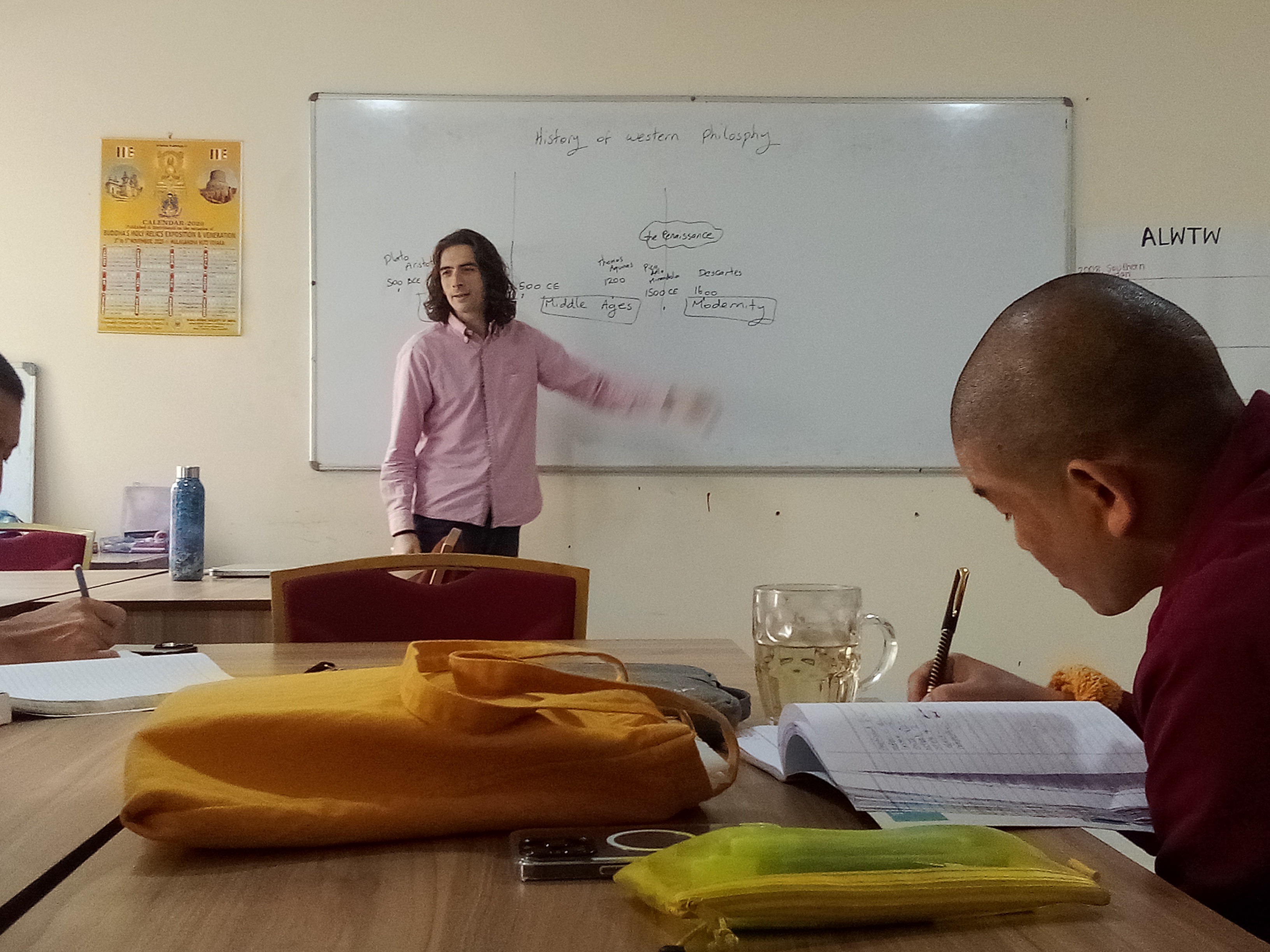
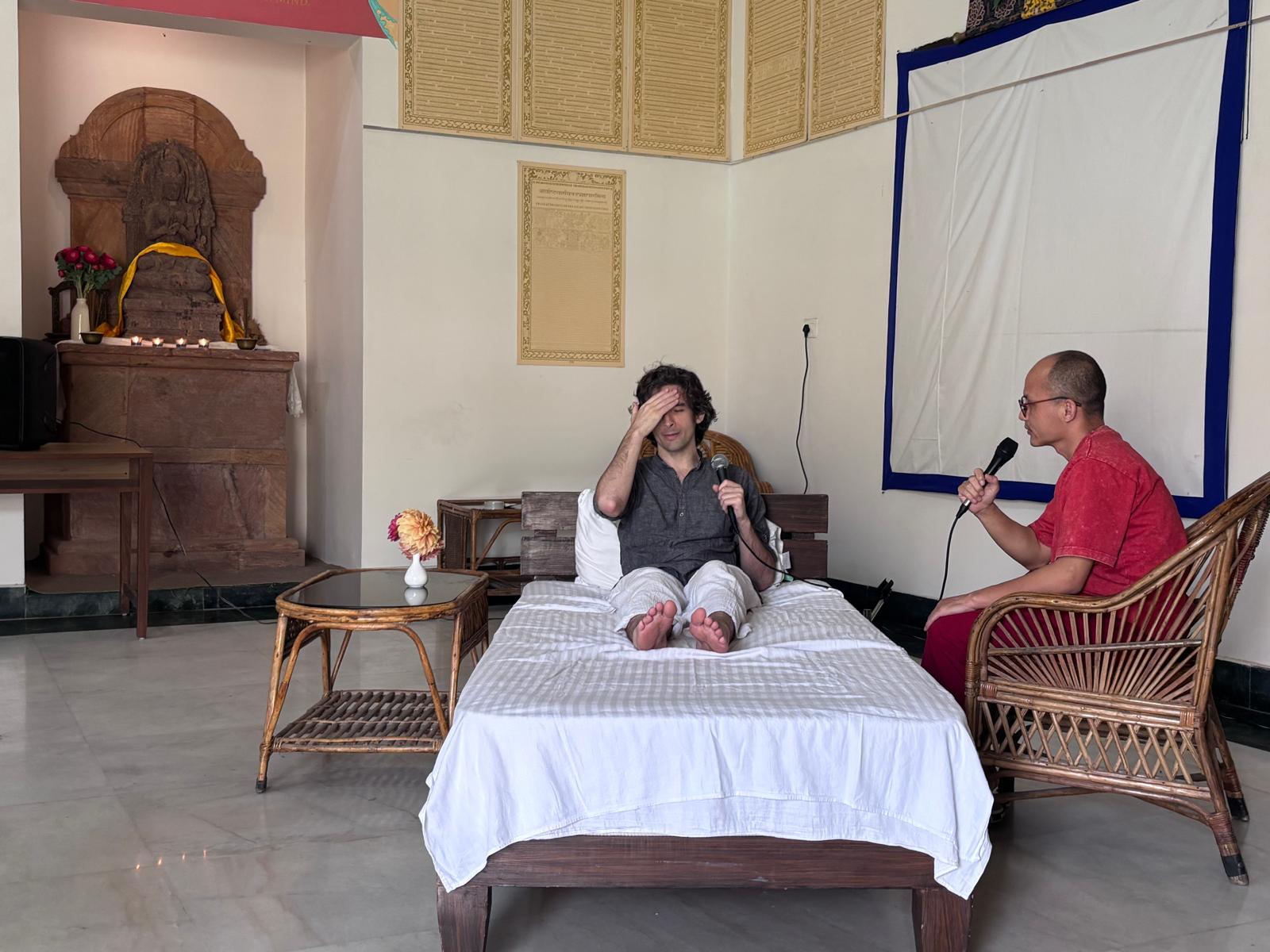 Teacher Jaime in class on Buddhist Chaplaincy with Elaine Yuen
”I felt at times like an alien that didn’t quite fit in.”
At SINI, teachers don’t just teach and go home. They live where their students live. They share every meal, play sports, and have tea together in the evening. For someone who describes himself as an introvert, this took some adjusting.
“Living in a community where almost everyone is from the Himalayan region and a majority have spent most of their lives as monastics, I had the impression that sometimes we didn’t quite understand each other. The differences were subtle but persistent: senses of humor, manners, ways of being polite, social cues. It was a little uncomfortable for the first few months, because I felt at times like an alien that didn’t quite fit in. Apart from that, community life can feel tiring at times, because I often like my own space.”
He found ways to balance it, like recharging in his room or spending quiet weekends reading at a nearby retreat center. But over time, the distance dissolved on its own.
“Now I feel at home. Even though we are from quite different worlds, with very different life experiences, the things that we have in common are enough. We all want to learn, we all want to study, we all appreciate the values of compassion and spiritual practice. And there is that basic human connection: we all want the best for each other.”
“We’re not in a rush.”
Teaching at SINI also required Jaime to rethink what he knew about running a classroom. Before SINI, he had taught English at a community college in the UK and in a private school in Spain. He came with a certain idea of what a good class should look like: dynamic, fast-paced, almost entertaining. Keeping up a certain pace. Doing one activity for five minutes and another for ten.
At SINI, that model didn’t work.
The topics are different. Rather than “what’s your favorite movie?” or “where do you want to go on vacation?”, SINI classes involve discussions of Buddhist philosophy, world religions, ethics, and world history. They are subjects that need time to digest. And the linguistic gap is enormous: Tibetan grammar has almost nothing in common with English and some monks arrived with very little English to start with.
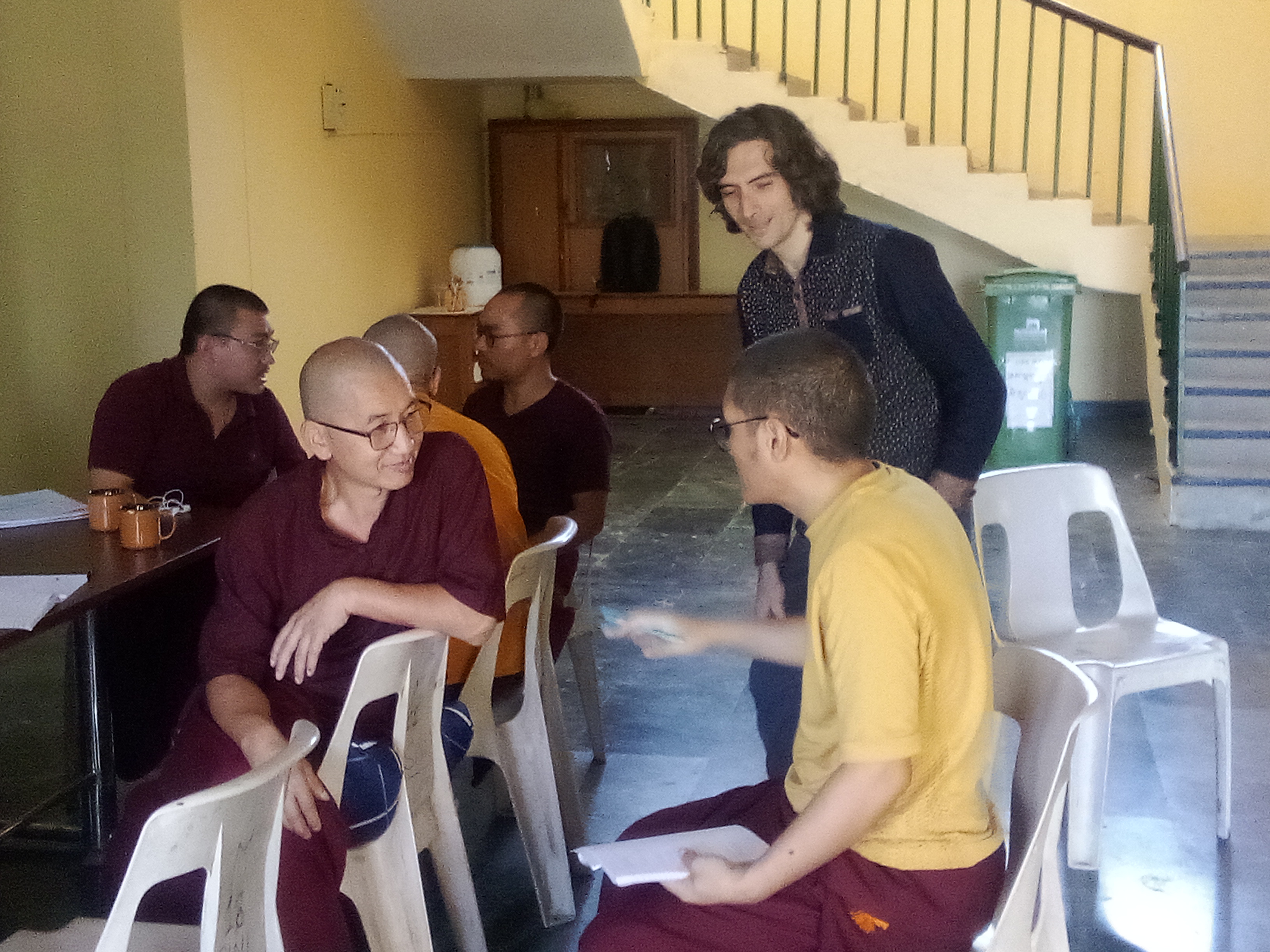
“In my previous experience of teaching ESL, I often felt a pressure to perform and to make the class ‘exciting.’ But with the monastics, once we get to know each other and we all realize we’re here for good motivations, there is more of a sense of: ‘OK, now we can take our time. We can let the knowledge and understanding develop at their own pace. We’re not in a rush.’”
“That sounds good, you should try it.”
That slower pace opens up space for new ideas. Together with the other teachers, Jaime helped introduce Workshop Wednesdays, a weekly joint session on topics the monks haven’t encountered in their monasteries.
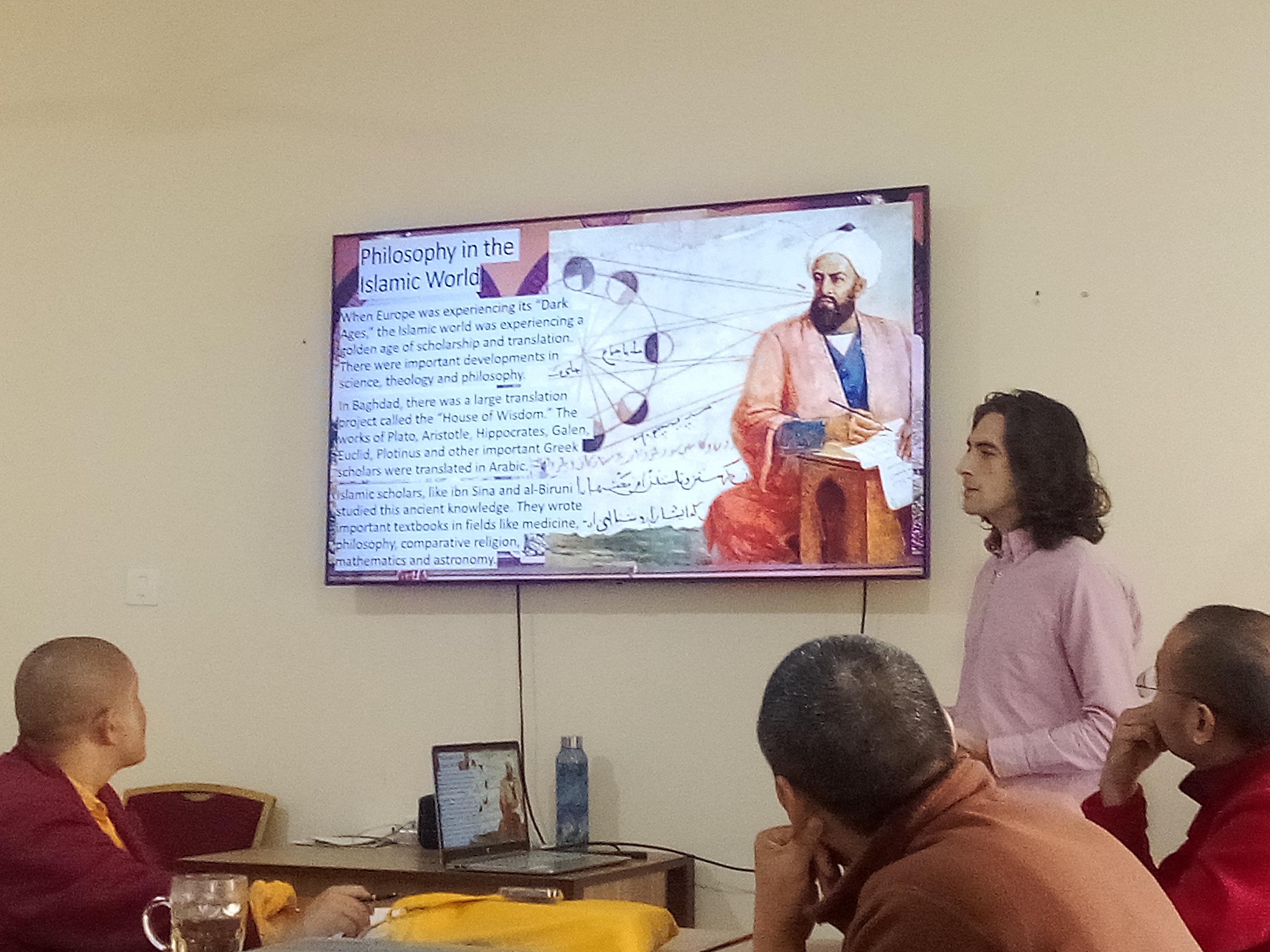
“Last week Piyali, our new teacher, did a drawing and art workshop where each monk was asked to draw a situation or a memory where someone was kind to them. That was really nice. I was moved to see their memories and images of what kindness means to them. The week before, I had given a workshop on the different branches of science, showing basic points about sciences like physics, geology and cosmology. I showed them slides with pictures of galaxies and rocks to give some ideas of what science can cover. Next week I am planning to present an overview of psychology.”
The workshops often grew out of conversations with the students. Philosophy, science, and other world religions often came up as subjects the monastics wanted to learn more about, which, for Jaime, was a gift.
“In a typical ESL class, students might be interested in talking about business or their next vacation. But I happen to love talking about philosophy, religion, and science, so I’ve found the curriculum we follow at SINI very engaging. I feel very fortunate to have worked with these students.”
These Workshop Wednesdays are part of a broader culture at SINI:
“I really appreciate this about SINI: there has been space for us as teachers to bring in new ideas. Not everything is fixed according to a predetermined specification. I’ve seen all of the teachers bringing new ideas to the table, and Tsering and others at SINI have been very receptive. I felt really valued in that sense.”
“This reminds me of Tibet.”
We spoke with Jaime from Bir, where the SINI community is spending the summer. Every year, the whole group moves from Sarnath to the Himalayan foothills. The schedule stays the same, the people stay the same, but somehow the atmosphere is very different.
“The monks seem happier in the summer. They’re in a natural environment that they find comfortable and familiar. They sometimes point to the mountains and the lush, green valleys around us and say, ‘Oh, this reminds me of Tibet. This feels like home.’ There’s a sense of almost being on vacation, with the pleasantly warm weather and fresh mountain air, because on weekends we can do fun things like walk in the hills, bathe in nearby rivers or have a picnic in the forest.”
This year in Bir, something new happened. A student asked Jaime if he had any local friends who could help him practice his English conversation skills. Thinking other students might benefit from a similar exchange, Jaime reached out through a few local WhatsApp groups and now many of the monks have been assigned a conversation partner: lay practitioners who are excited to talk to monks and ask them questions about Dharma.
“I don’t think that would happen in Varanasi.”
Bir, with its monasteries and meditation centers, draws visitors who stay for months to practice and study. It creates a natural meeting ground between the world the monks come from and the world they’re learning to speak to.
“Sometimes we have to move on.”
Jaime’s employment visa expires at the end of this summer. He is considering different further steps, including teaching ESL in another country and postgraduate research in religious studies.
When he reflects on what he’s been part of, he points to the concept of translation: not only between languages, but between different ways of understanding the world.
“Our monastics are in a sense like ambassadors of the Buddha’s teachings, as well as of their Himalayan culture. They have the ability as scholars to explain the Dharma to different people around the world. On the other hand, as English teachers here, we are acting like ambassadors of Western culture, Western education, and in many ways global culture. We’re in a kind of mediation process, trying to translate between two different worlds: building bridges of mutual understanding and friendship across them.”
Still, leaving is not easy.
“I will miss a lot of things about being at SINI. It’s been such a lovely project and life experience. But, as we know, impermanence is part of life. We have to move on sometimes.”
We wish Jaime the very best as he begins this new chapter and thank him for all of his kindness, generosity, and care. May he keep learning, teaching, and building bridges wherever he goes.